
← Guides Peptide 101
Reconstitution Solutions
Bacteriostatic 0.9% Sodium Chloride Injection, USP (MDV)
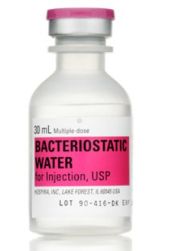
- **What it is:**A sterile, nonpyrogenic, isotonic solution of sodium chloride in water for injection. It contains 0.9% NaCl and 0.9% benzyl alcohol as a preservative. Comes in a multi-dose vial (MDV).
- **Why it’s used:**The presence of benzyl alcohol makes it bacteriostatic, meaning it prevents bacterial growth. This allows for multiple withdrawals from the same vial without significant contamination risk, making it more convenient for ongoing peptide use.
Sterile Water for Injection (SDV)
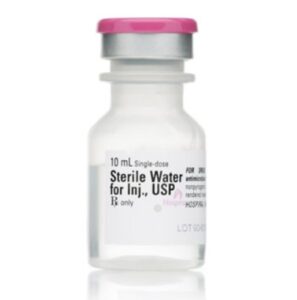
- **What it is:**Sterile, nonpyrogenic, pure water packaged in single-dose vials (SDV). Contains no preservatives.
- **Why it’s used:**Because it is preservative-free, it must be used all at once after opening (not suitable for long storage). It is the most neutral diluent, making it a universal option for short-term use or for peptides that are sensitive to benzyl alcohol.
Sodium Bicarbonate 8.4%
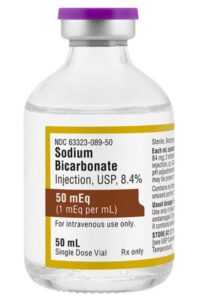
- **What it is:**A sterile, alkaline solution containing sodium bicarbonate (NaHCO₃).
- **Why it’s used:**Some peptides are unstable in acidic environments and require a buffered alkaline solution for stability. Sodium bicarbonate raises pH, protecting peptides that are prone to degradation in neutral or acidic solutions.
Sodium Chloride 0.9% (Normal Saline)
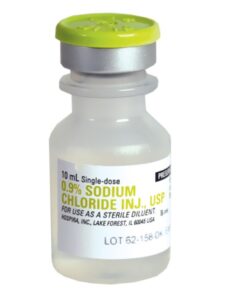
- **What it is:**A sterile isotonic saline solution (salt water), containing 0.9% sodium chloride in water. It may be supplied in either SDV or MDV forms depending on the manufacturer.
- **Why it’s used:**Provides an isotonic environment (matching body fluid osmolarity), reducing injection irritation. However, unlike bacteriostatic saline, it does not contain benzyl alcohol, so it should ideally be used within a single session.
Lidocaine 2% (MDV)
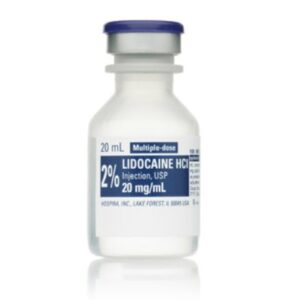
- **What it is:**A local anesthetic solution, usually available in multi-dose vials.
- **Why it’s used:**Lidocaine is not commonly used as a peptide diluent, but in some underground research settings it has been mixed with irritant peptides to reduce injection pain. However, this should be done cautiously, since lidocaine can destabilize certain peptide structures and is not considered a suitable long-term diluent.
GA (Glycerin + Acetic Acid + Benzyl Alcohol, “AOD Water”) – MDV
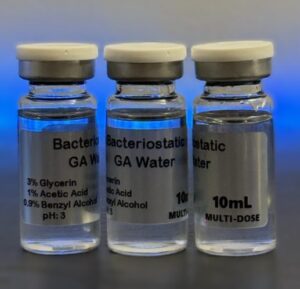
- **What it is:**A specialty diluent composed of 3% glycerin, 1% acetic acid, and 0.9% benzyl alcohol, giving a final solution with a pH around 3. Supplied in a multi-dose vial (MDV).
- Why it’s used:Provides stability for peptides that degrade rapidly in neutral solutions. The acidic environment (thanks to acetic acid) extends shelf life, while glycerin reduces sting upon injection, and benzyl alcohol prevents bacterial growth.
- Peptide examples:Most commonly used with AOD-9604 (hence “AOD water”), but also suitable for fragile metabolic peptides like MOTS-c and analogues that prefer acidic stabilization.
Bacteriostatic 0.9% Sodium Chloride (MDV)
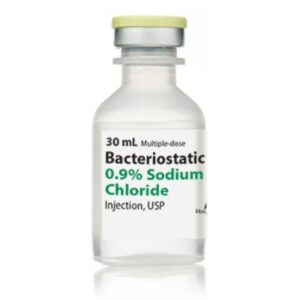
- What it is:
A sterile, nonpyrogenic, isotonic solution of sodium chloride (0.9%) in water for injection. It contains benzyl alcohol (0.9%) as a preservative. Packaged in multi-dose vials (MDV), which means you can safely withdraw multiple times without immediate risk of bacterial contamination. - Why it’s used:
The addition of benzyl alcohol makes the solution bacteriostatic — it prevents bacterial growth in the vial. This gives it a longer usable life after reconstitution compared to sterile water or plain saline, which are single-use only. It’s especially valuable for peptides that are dosed daily or multiple times per week, since one reconstituted vial can be used over several weeks if stored properly (usually refrigerated).