
What are COAs?
What Are COAs (Certificates of Analysis)?
Why You Should Never Inject a Peptide Without One If you’re using peptides—or thinking about it—there’s one document you need to understand: The COA. That stands for Certificate of Analysis, and it’s the lab report that tells you exactly what’s in your vial. If a peptide doesn’t have a COA, don’t use it. Plain and simple.
🧪 What Is a COA?
A Certificate of Analysis is a quality control document from a third-party lab that confirms:
- Purity of the compound (usually expressed as a percentage)
- Identity of the compound (so you know it’s what the label says it is)
- Absence of contaminants (like bacteria, heavy metals, solvents, or endotoxins)
- Batch number (so you know the report matches your vial)
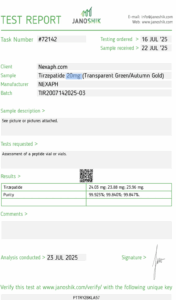
In short, it’s the peptide’s receipt + lab report + ID card—all in one. Example of a COA:
🔍 What to Look For
When reviewing a COA, here are the key things to check: ✅ Batch number — It should match what’s on your vial or box ✅ Purity % — You want 98% or higher ✅ Test results — Look for HPLC, MS, or endotoxin testing ✅ Lab name — It should be from a legit third-party testing lab, not the seller themselves ✅ Date tested — Make sure it’s recent and not expired If the COA doesn’t check these boxes, it’s a red flag.
⚠️ No COA = No Trust
A peptide without a COA is like a car without a VIN. You have no idea where it came from, what’s in it, or what you’re putting into your body. Some sketchy vendors will send a generic “example COA” or one that doesn’t match your vial’s batch number. That’s not good enough. You need a real, specific, traceable COA tied to your product.
👀 Why This Matters
You’re injecting this stuff into your body. You should know for sure:
- It’s clean
- It’s real
- It’s dosed correctly
- And it’s not filled with junk, bacteria, or worse
The COA is your proof. No guesswork. No crossing fingers.
Quick Example
Say you get a vial labeled “Tesamorelin.” Without a COA, it could be:
- Under-dosed
- A completely different peptide
- Full of contaminants
- Or nothing at all
But with a real COA, you know:
Batch #TS-0289
Tested 6/15/25
98.7% purity
Endotoxin-free
Verified by XYZ Labs
Now you’re not guessing—you’re confident.
The Bottom Line
Never inject a peptide that doesn’t come with a COA. No matter how pretty the label looks. No matter how many good reviews the seller has. No matter how much you want to believe it’s fine. A real COA protects your health and proves the product is legit. Anything less is a gamble—and it’s not worth the risk.